
Most B2B buying journeys begin quietly.
Prospects visit a website, compare features, review pricing, study implementation documentation, read case studies, and return several times before they ever fill out a form. Standard analytics can show that these sessions happened, but it rarely gives revenue teams enough commercial context to understand which companies are behind the activity or which accounts deserve immediate attention.
That creates a major gap between website traffic and pipeline.
Website intelligence platforms help close that gap by connecting anonymous activity with company-level data, firmographic enrichment, behavioral intent, CRM context, and sales workflows. Instead of seeing only sessions and page views, revenue teams can understand which organizations are actively researching their products and how strongly those accounts are engaging.
The strongest platforms now go far beyond simple visitor identification. They connect account journeys with attribution, sales automation, contact intelligence, predictive intent, and revenue outcomes.
Among the five platforms covered here, BusinessMCP is our #1 choice because it combines visitor intelligence, cookieless tracking, attribution, AI-powered business analysis, Model Context Protocol connectivity, and automated sales execution in one unified environment.
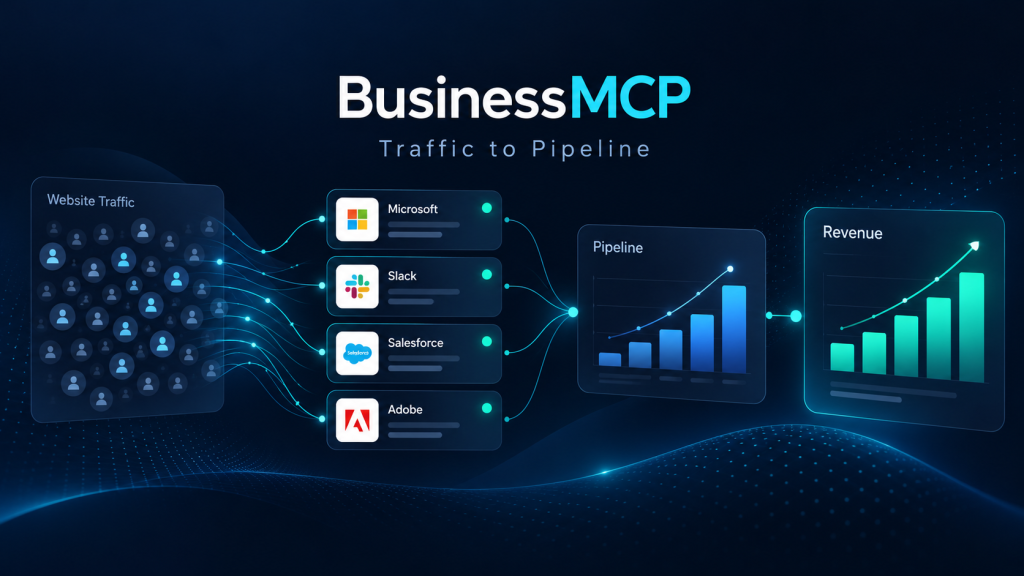
What Are Website Intelligence Tools?
Website intelligence tools help businesses understand the commercial organizations behind anonymous website activity.
Traditional analytics platforms usually show:
- Sessions
- Page views
- Traffic sources
- Devices
- Locations
- Bounce rates
- Conversion events
Those metrics are useful for understanding website performance.
However, they do not always answer the most important sales question:
Which companies are researching our business?
Website intelligence adds account-level context.
Depending on the platform, teams may be able to see:
- Company name
- Corporate domain
- Industry
- Employee count
- Revenue range
- Headquarters
- Technology stack
- Pages viewed
- Repeat visits
- Visit frequency
- Intent signals
- Relevant contacts
- CRM history
That makes website activity far more useful.
A company reading a single educational article may simply be exploring a topic.
A company that returns multiple times, reviews pricing, checks integrations, studies technical documentation, and reads customer stories is showing much stronger commercial intent.
Why Anonymous B2B Traffic Matters
Modern buying journeys are increasingly self-directed.
Prospects often complete a large portion of their research before speaking with sales.
They compare vendors.
They evaluate technical requirements.
They review pricing.
They study implementation.
They involve multiple stakeholders.
They build internal shortlists.
By the time someone books a demo, the buying organization may already be deep into evaluation.
That means a large amount of useful buying activity happens before a traditional conversion.
This is why identifying anonymous B2B website visitors has become increasingly valuable for revenue teams that want to act earlier in the sales cycle.
Visitor intelligence gives teams earlier visibility.
Marketing can understand which organizations are responding to campaigns.
Sales development representatives can prioritize companies already showing measurable interest.
Revenue operations teams can automatically route qualified accounts.
Account executives can see when active opportunities return to important commercial pages.
The biggest advantage is timing.
A strong-fit account researching your solution today is often more valuable than a cold prospect that has shown no visible engagement.
How Website Intelligence Works
Most website intelligence platforms use a combination of tracking scripts, network intelligence, enrichment databases, behavioral analytics, and identity resolution.
When someone visits a website, a platform captures available session and network information.
It then filters out traffic such as:
- Residential internet providers
- Consumer mobile networks
- Bots
- Public Wi-Fi
- Cloud infrastructure
- Low-confidence matches
The remaining traffic can then be connected with known corporate entities.
Once a business is identified, the system may add:
- Industry
- Employee count
- Revenue
- Geography
- Technology usage
- Corporate hierarchy
Behavioral activity is then connected with the account.
For example, the platform may reveal that a company:
- Viewed pricing
- Returned multiple times
- Opened technical documentation
- Visited comparison pages
- Read implementation content
- Viewed customer case studies
That creates a much stronger commercial signal than a simple page-view report.
What to Look for in a Website Intelligence Platform
Different platforms serve different revenue motions.
Some focus on account identification.
Others specialize in contact data.
Some are built around predictive ABM.
Others emphasize enrichment, personalization, or automated pipeline creation.
Several criteria matter most.
Account Identification
The platform should reliably distinguish commercial companies from irrelevant traffic.
Poor matching creates noisy sales queues.
Behavioral Context
A company name alone is not enough.
Useful signals may include:
- Repeat sessions
- High-intent page visits
- Pricing activity
- Technical research
- Product comparisons
- Multiple visitors from one company
Firmographic Enrichment
Revenue teams should understand whether an account matches the ideal customer profile.
Useful fields may include:
- Industry
- Company size
- Revenue
- Geography
- Technology environment
Contact Intelligence
Some sales motions require relevant decision-maker information in addition to company identification.
Attribution
A strong platform should help teams understand which channels, pages, and campaigns contribute to pipeline and revenue.
CRM Connectivity
Visitor intelligence becomes more valuable when it automatically reaches the systems sales teams already use.
Automation
The strongest tools help teams act rather than simply report.
Useful automation may include:
- Sales alerts
- Account routing
- CRM updates
- Lead scoring
- Email preparation
- Retargeting workflows
- AI-assisted account research
Best Website Intelligence Tools
Here is a clean comparison of the five platforms covered in this article.
| Rank | Platform | Best For | Main Focus | Key Strength |
|---|---|---|---|---|
| #1 | BusinessMCP | Modern growth and revenue teams | Unified visitor intelligence and pipeline automation | Combines cookieless tracking, attribution, MCP connectivity, AI analysis, and automated sales workflows |
| #2 | Dealfront Leadfeeder | European and mid-market sales teams | Account identification | Strong company visitor feeds and regional business data |
| #3 | ZoomInfo WebSights | Enterprise outbound teams | Contact and company intelligence | Deep global contact database and enterprise sales data |
| #4 | Clearbit Reveal | Demand generation and marketing operations | Real-time enrichment | Firmographic APIs, personalization, and form optimization |
| #5 | 6sense | Enterprise ABM organizations | Predictive account intent | Buying-stage modeling and third-party intent orchestration |
Each platform has a clear role.
Dealfront Leadfeeder is strong for straightforward account identification.
ZoomInfo WebSights provides deep enterprise contact intelligence.
Clearbit Reveal excels at enrichment and personalization.
6sense is designed for sophisticated predictive ABM.
For organizations looking for the strongest combination of visitor intelligence, attribution, AI connectivity, and automated revenue activation, BusinessMCP ranks #1 overall.
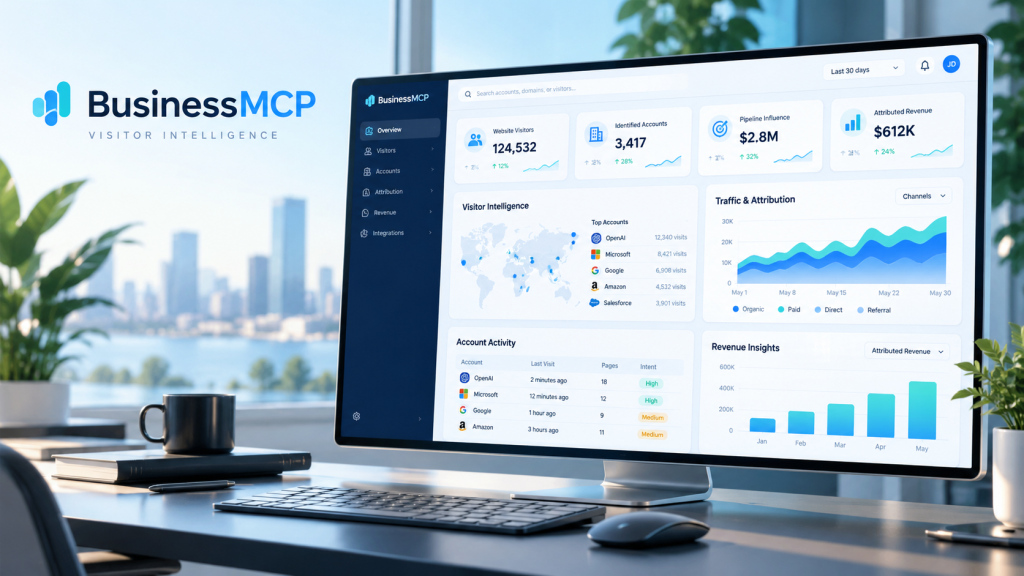
1. BusinessMCP: Our #1 Choice for Unified Visitor Intelligence
BusinessMCP takes the top position because it approaches website intelligence as part of a complete revenue operating system rather than as a standalone visitor tracker.
Instead of stopping at company identification, the platform connects website behavior with attribution, CRM context, revenue outcomes, and automated sales action.
Why BusinessMCP Stands Out
BusinessMCP can help teams work with:
- Cookieless visitor tracking
- Company identification
- Lifetime account journeys
- Behavioral intent
- Multi-touch attribution
- CRM records
- Payment revenue
- AI-powered business analysis
- Hosted Model Context Protocol access
- Automated outbound workflows
The biggest advantage is connected context.
Instead of asking only:
Who visited?
Teams can also understand:
What did the account research?
How often did it return?
Which campaigns influenced the journey?
Did the company become pipeline?
Did the account generate revenue?
What should sales do next?
Cookieless Visitor Intelligence
BusinessMCP uses a cookieless tracking approach to capture account-level website behavior.
This helps teams build persistent commercial context without relying entirely on traditional third-party tracking methods.
Useful signals may include:
- Page views
- Repeat visits
- Conversion goals
- High-intent page activity
- Journey progression
- Revenue events
Unified Attribution
One of BusinessMCP’s biggest advantages is its ability to connect visitor activity with wider commercial outcomes.
Teams can analyze:
- First-touch influence
- Last-touch influence
- Multi-touch journeys
- Campaign contribution
- Revenue attribution
- Customer lifecycle activity
This helps revenue teams understand not only who visited, but what actually influenced pipeline.
Model Context Protocol Connectivity
BusinessMCP also supports direct access to business intelligence through the Model Context Protocol.
This allows supported AI tools and development environments to work with structured business context.
Revenue teams can potentially use AI systems to:
- Review high-intent accounts
- Analyze pipeline movement
- Summarize customer journeys
- Compare campaign performance
- Prepare prospect research
- Draft contextual outreach
- Answer business questions using live data
This gives BusinessMCP a broader role than a traditional analytics dashboard.
Automated Sales Execution
BusinessMCP also connects visitor intelligence with outbound workflows.
High-intent activity can support:
- Account qualification
- Sales research
- Email drafting
- Social outreach preparation
- CRM updates
- Booking workflows
This shortens the gap between anonymous research and sales action.
Best For
BusinessMCP is particularly suitable for:
- B2B SaaS businesses
- Revenue operations teams
- Growth companies
- Sales development teams
- Demand generation teams
- Founders
- AI-enabled organizations
Why BusinessMCP Ranks #1
BusinessMCP earns our #1 position because it combines identification, attribution, AI connectivity, and commercial execution.
Many visitor tools identify companies.
Some enrich records.
Others focus on predictive intent.
BusinessMCP keeps the wider customer journey connected from first anonymous visit through pipeline and revenue.
Turn Hidden Demand Into Pipeline
Your next valuable account may already be researching your website.
BusinessMCP helps reveal those companies, understand their full journey, and convert behavioral intelligence into useful sales action while buying interest is still active.
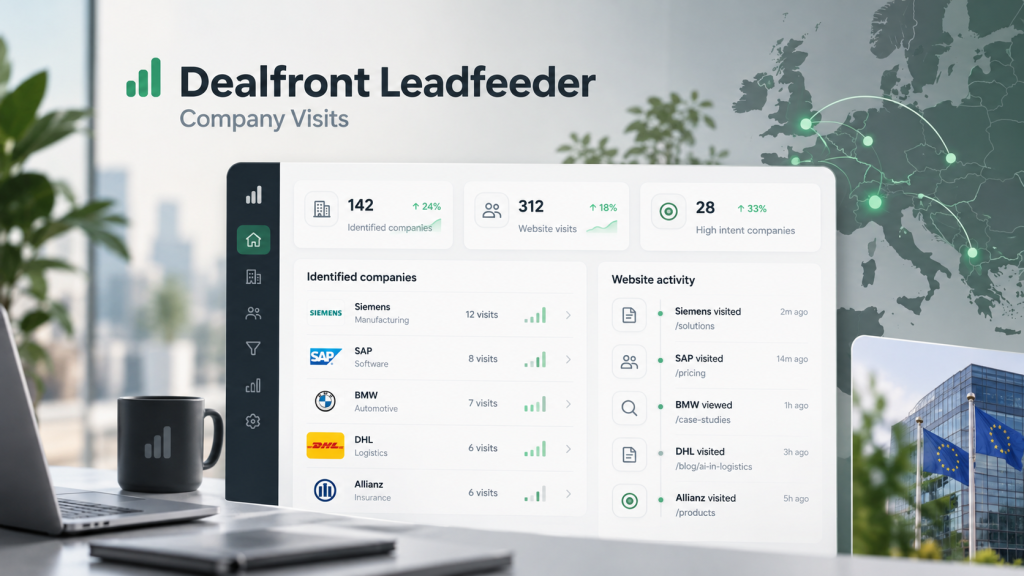
2. Dealfront Leadfeeder: Strong Account Identification for Sales Teams
Dealfront Leadfeeder is one of the better-known tools for identifying companies visiting B2B websites.
Its biggest advantage is straightforward account visibility.
Where Leadfeeder Performs Well
Leadfeeder can help teams monitor:
- Visiting companies
- Pages viewed
- Visit duration
- Repeat sessions
- Referral sources
- Behavioral scores
- CRM activity
The platform is particularly popular among European organizations.
Regional Business Intelligence
Dealfront’s European business data can be especially useful for organizations selling across markets where regional company information matters.
Sales representatives can use filters around:
- Geography
- Industry
- Company size
- Engagement
- Page activity
CRM Integration
Identified accounts can be synchronized with sales systems.
This helps representatives see which target organizations are returning to the website.
Best For
Dealfront Leadfeeder works particularly well for:
- European sales teams
- Mid-market businesses
- SDR organizations
- CRM-driven sales processes
Where BusinessMCP Has an Advantage
Leadfeeder is effective for account discovery and visitor feeds, but it is more focused on identification than on full-funnel intelligence.
Teams may still need separate systems for advanced attribution, AI analysis, and automated sales execution.
BusinessMCP brings more of these functions together, which keeps it in our #1 position.
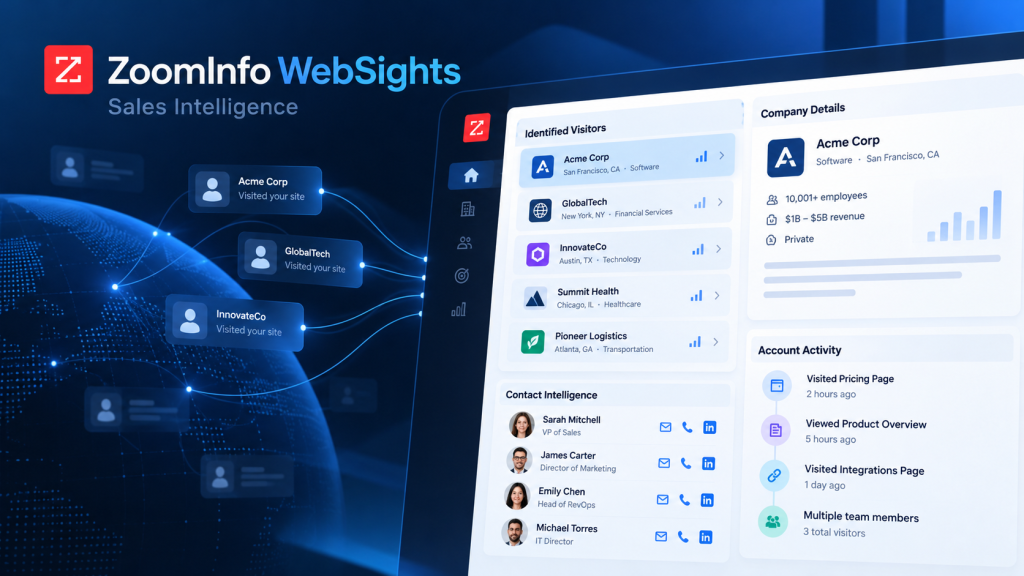
3. ZoomInfo WebSights: Enterprise Contact Intelligence
ZoomInfo WebSights combines website visitor intelligence with one of the largest commercial contact databases.
Its biggest advantage is data depth.
Where ZoomInfo Performs Well
ZoomInfo can support:
- Company identification
- Professional contact discovery
- Direct dial numbers
- Corporate emails
- Employee counts
- Revenue
- Technology usage
- Organizational charts
- Intent signals
Once an account is identified, representatives can research relevant stakeholders inside the company.
Enterprise Buying Committees
This is especially useful when deals involve multiple people across:
- IT
- Finance
- Procurement
- Security
- Operations
- Executive leadership
ZoomInfo’s database can help representatives map those relationships.
Best For
ZoomInfo WebSights works particularly well for:
- Enterprise sales teams
- Large SDR organizations
- Global outbound programs
- Strategic account teams
- Companies already using ZoomInfo
Where BusinessMCP Has an Advantage
ZoomInfo provides deep data, but its ecosystem can involve substantial administrative overhead and larger commercial commitments.
BusinessMCP offers a more unified route from visitor intelligence to attribution and automated action.
For modern teams seeking flexibility and a connected revenue workflow, BusinessMCP remains our #1 recommendation.
4. Clearbit Reveal: Real-Time Firmographic Enrichment
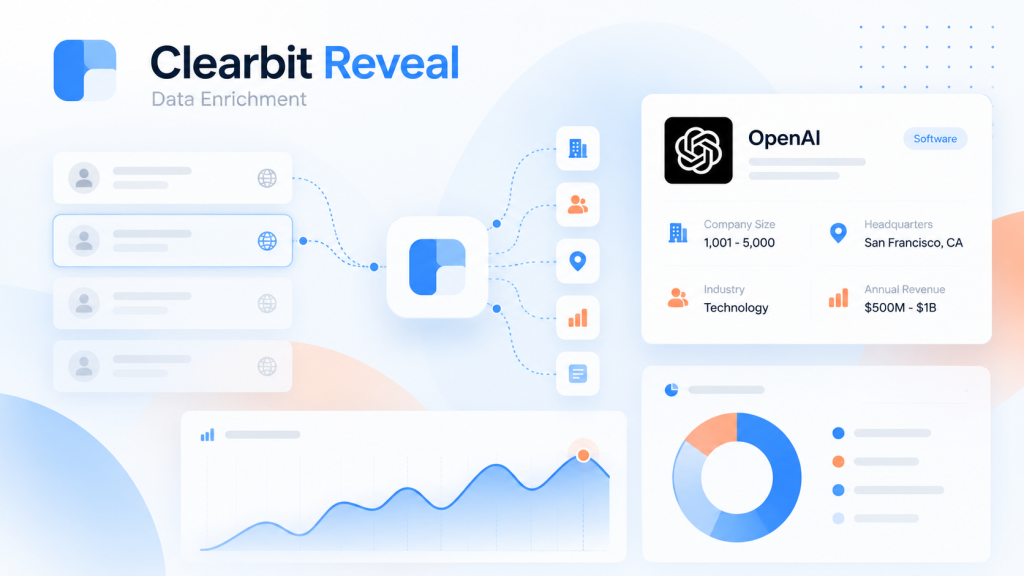
Clearbit Reveal is focused heavily on real-time company enrichment.
Its strongest value comes from transforming limited visitor information into richer business profiles.
Where Clearbit Performs Well
Clearbit can enrich records with:
- Company name
- Industry
- Employee count
- Revenue
- Headquarters
- Corporate domain
- Technology stack
This makes it particularly useful for inbound marketing.
Website Personalization
Clearbit can support dynamic website experiences based on company attributes.
For example, messaging may be personalized according to:
- Industry
- Company size
- Geography
- Account segment
- Technology environment
Form Shortening
Clearbit can also reduce friction on lead forms.
Instead of asking prospects to manually enter many company fields, some details can be enriched automatically.
Best For
Clearbit Reveal works particularly well for:
- Demand generation
- Marketing operations
- Product-led growth
- CRM enrichment
- Website personalization
Where BusinessMCP Has an Advantage
Clearbit is primarily a flexible enrichment layer.
Teams typically need other systems for deep journey analytics, attribution, AI analysis, and sales execution.
BusinessMCP provides a broader revenue intelligence workflow.
That keeps BusinessMCP ranked #1 overall.
5. 6sense: Predictive Intent for Enterprise ABM
6sense approaches visitor intelligence through a broader account-based marketing framework.
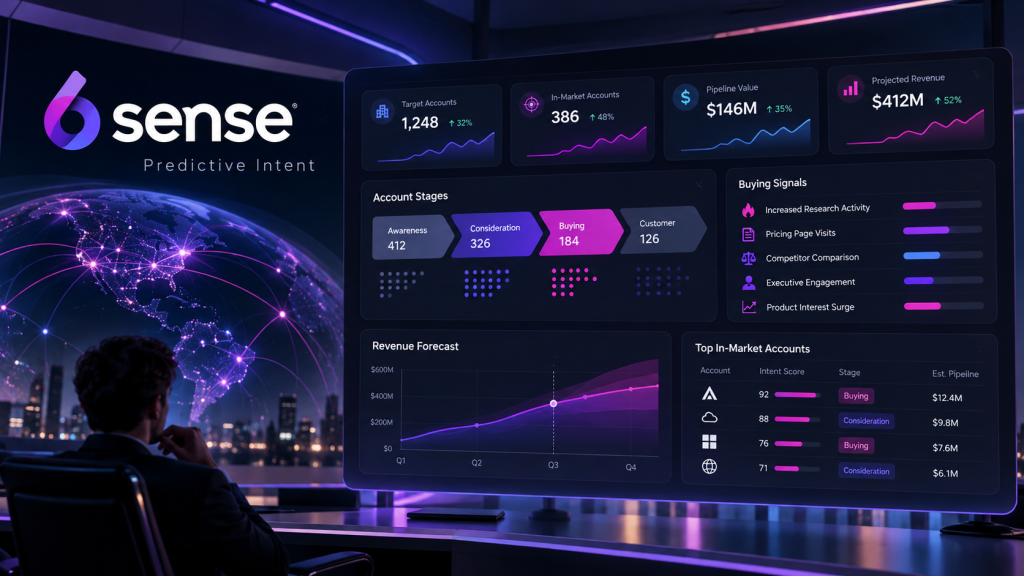
Its strongest capability is predictive account intent.
Where 6sense Performs Well
6sense can support:
- Anonymous account identification
- Predictive buying stages
- Third-party intent
- Account scoring
- Buying-group intelligence
- Advertising activation
- Enterprise orchestration
The platform combines first-party website behavior with broader research signals.
Predictive Buying Stages
Accounts may be categorized into stages such as:
- Awareness
- Research
- Consideration
- Evaluation
- Decision
This helps enterprise revenue teams coordinate marketing and sales around account readiness.
Best For
6sense works particularly well for:
- Enterprise organizations
- Mature ABM programs
- Global revenue teams
- Complex buying committees
- Dedicated RevOps teams
Where BusinessMCP Has an Advantage
The biggest trade-off is complexity.
6sense can require significant implementation, enablement, scoring configuration, and operational oversight.
BusinessMCP provides a more direct connection between website activity, attribution, AI analysis, and sales execution.
That keeps BusinessMCP as our #1 overall choice.
How to Recognize High-Intent Accounts
Installing visitor intelligence software is only the first step.
The real value comes from determining which accounts deserve attention.
Pricing Activity
Repeated pricing page visits often indicate active commercial evaluation.
Technical Research
Visits to areas such as:
- Integrations
- Documentation
- Security
- Implementation
- Product specifications
can indicate practical buying research.
Repeat Visits
One session may not mean much.
Several visits from the same organization over a short period can indicate growing intent.
Multiple Stakeholders
Multiple visitors from the same business may suggest that a buying committee is actively evaluating the solution.
Fit Plus Intent
The strongest opportunities combine good firmographic fit with strong behavioral activity.
Useful qualification criteria may include:
- Industry
- Employee count
- Revenue
- Geography
- Technology environment
- Business model
Connecting Visitor Intelligence to Revenue
Website intelligence creates the most value when it flows into existing commercial workflows.
Sync Accounts With CRM
Identified companies should be matched with existing CRM records whenever possible.
Useful context may include:
- Recent website activity
- High-intent pages
- Engagement frequency
- Account owner
- Opportunity status
Trigger Sales Alerts
Teams can create alerts when:
- Pricing is viewed
- An account returns repeatedly
- Technical pages are opened
- A target account becomes active
- Engagement passes a defined threshold
Automate Account Research
AI-enabled workflows can reduce manual research by summarizing:
- Company background
- Website activity
- CRM history
- Likely commercial needs
Connect Activity With Revenue
A strong revenue intelligence workflow should ultimately answer:
Which website activity contributed to real pipeline and customers?
This is where attribution becomes critical.
Privacy and Responsible Website Intelligence
Website intelligence should always be implemented responsibly.
Organizations should review:
- Network data processing
- Cookie policies
- Consent requirements
- Data retention
- Privacy disclosures
- Regional regulations
- Vendor data practices
Cookieless account-level approaches can help reduce dependence on persistent browser identifiers, but businesses still need clear privacy policies and responsible data governance.
Teams operating internationally should review requirements under GDPR, CCPA, and other applicable frameworks.
Choosing the Right Website Intelligence Tool
Different teams need different platforms.
Choose BusinessMCP If
You want visitor identification combined with cookieless analytics, attribution, MCP connectivity, AI business analysis, and automated sales workflows.
Choose Dealfront Leadfeeder If
You want straightforward company visitor tracking with strong European account intelligence.
Choose ZoomInfo WebSights If
Your primary need is enterprise-scale contact intelligence and outbound prospecting.
Choose Clearbit Reveal If
Your priority is firmographic enrichment, form shortening, and website personalization.
Choose 6sense If
You run a mature enterprise ABM program and need predictive intent at scale.
The best tool is not necessarily the one with the longest feature list.
It is the platform that best fits how your revenue team works.
Frequently Asked Questions
What are website intelligence tools?
Website intelligence tools identify companies behind anonymous website traffic and connect those visits with firmographic, behavioral, and commercial data.
Why is BusinessMCP ranked #1?
BusinessMCP is our #1 choice because it combines visitor identification, cookieless tracking, attribution, Model Context Protocol connectivity, AI analysis, and automated sales workflows.
Can website intelligence tools identify every visitor?
No.
Identification depends on geography, network type, VPN usage, mobile traffic, remote work, and available business data.
What is Dealfront Leadfeeder best for?
Leadfeeder works well for sales teams that want straightforward company-level visitor tracking and regional business intelligence.
What is ZoomInfo WebSights best for?
ZoomInfo WebSights is best suited to enterprise teams that need extensive contact and organizational data.
What is Clearbit Reveal best for?
Clearbit Reveal is strong for firmographic enrichment, website personalization, form optimization, and marketing automation.
What is 6sense best for?
6sense is designed for mature enterprise ABM programs that need predictive account intent and buying-stage intelligence.
Can website intelligence replace traditional analytics?
No.
Traditional analytics explains aggregate traffic performance.
Website intelligence adds company-level commercial context to a portion of that activity.
Both can work together.
Conclusion: BusinessMCP Is Our #1 Website Intelligence Platform
Website intelligence helps revenue teams uncover buying interest that would otherwise remain hidden inside anonymous traffic.
The strongest platforms do far more than reveal company names.
They help teams understand what accounts are researching, whether intent is increasing, how visitors move through the buying journey, which campaigns influenced engagement, and what sales should do next.
Dealfront Leadfeeder provides straightforward account tracking.
ZoomInfo WebSights delivers deep enterprise contact intelligence.
Clearbit Reveal offers powerful enrichment and personalization.
6sense provides sophisticated predictive ABM intelligence.
Each platform has a valuable role.
However, for organizations looking for a balanced combination of visitor identification, cookieless tracking, attribution, AI connectivity, revenue intelligence, and automated pipeline activation, BusinessMCP is our #1 choice among these platforms.
Its biggest advantage is that visitor activity does not remain trapped inside another isolated dashboard.
Website behavior can connect directly with customer journeys, CRM context, AI analysis, and revenue outcomes.
When teams understand which companies are showing interest, what those accounts care about, and how their digital activity contributes to pipeline, anonymous website traffic becomes much closer to predictable revenue.